

Think about what it means when a mining company sponsors a local conservation reserve near one of its operations — funding rangers, restoring a wetland, issuing a press release with photographs of native birds. It’s not that these things are worthless. It’s that they exist separately from the operation next door: the tailings, the water draw, the habitat cleared for the access road. The conservation sponsorship lets the company say it takes environmental stewardship seriously. It doesn’t require the company to change anything fundamental.
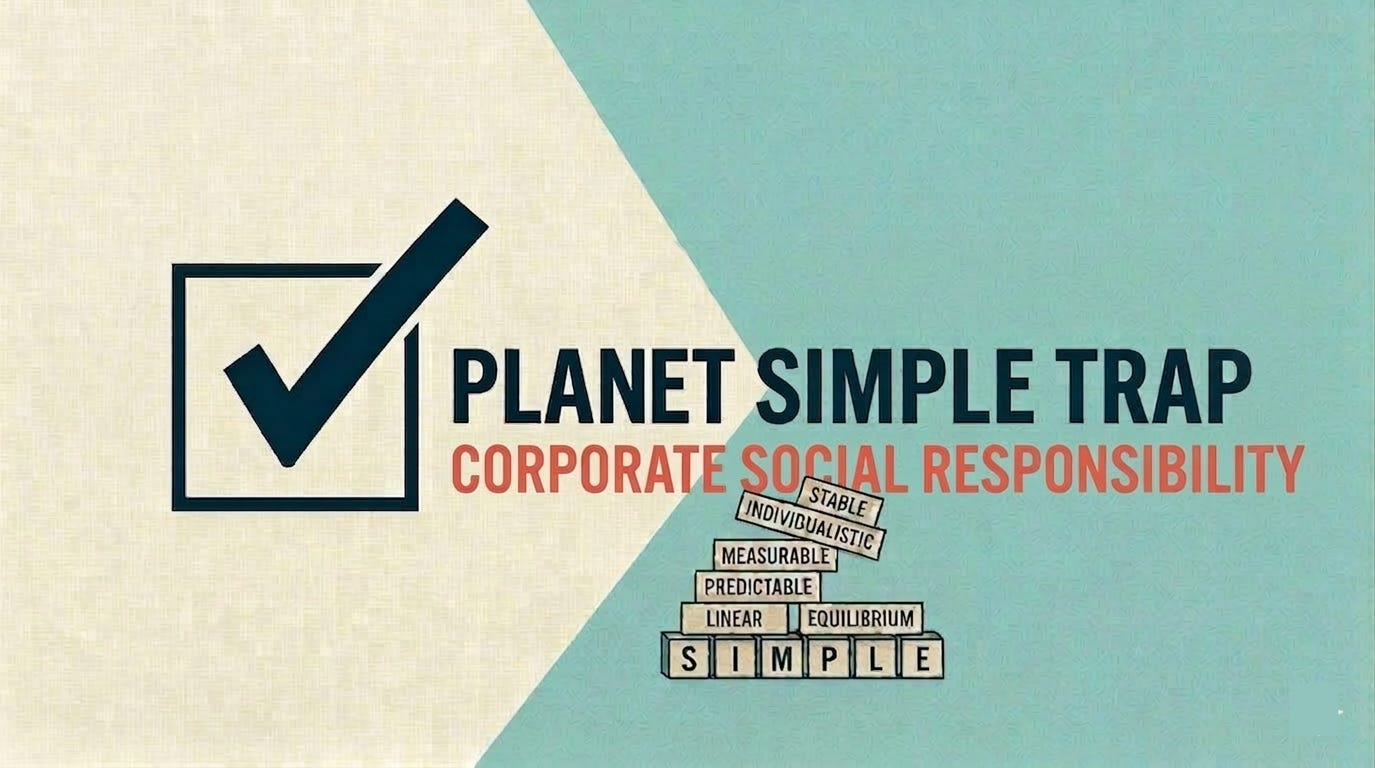
That structure — a parallel initiative designed to offset the impacts of the core operation without touching the core operation — is exactly how Corporate Social Responsibility works.
And it’s one of the most consequential Planet Simple traps in business today.
The Name Says It All
CSR as a movement emerged in the 1970s. The name itself reveals the assumption embedded in it: that business is, by default, irresponsible — and needs a dedicated strategy to balance that out. For the era, there was a certain logic to this. Industrial pollution was visible and localized. “Bad actors” could be identified. The solution was cleanup: add a responsibility layer to offset the damage.
The problem is that this cleanup model never left. It calcified into orthodoxy. Today, decades later, most large companies still treat sustainability as a separate function — staffed by a sustainability team, reported through a CSR or ESG report, funded as a cost center rather than integrated as a strategic imperative.
This is the CSR trap. Not because it’s dishonest, but because it’s structurally incapable of doing what it claims to do.
Philanthropy Is Not Sustainability
A lot of what gets called CSR is philanthropy: donations to nonprofits, employee volunteering programs, community partnerships. These activities are often genuinely good. The PR value is high. The emotional resonance is real. But conflating them with sustainability is where things go wrong.
Philanthropy addresses symptoms. Sustainability requires engaging with root causes — how the business model itself interacts with social and environmental systems. When a company funds a tree-planting initiative while expanding a supply chain with deforestation risk baked into it, it isn’t doing sustainability. It’s doing optics. And at some level, most sophisticated observers know the difference.
The deeper problem is what CSR does to the organization’s self-perception. If you have a CSR program, you’ve done sustainability. The work is complete. There’s no impetus to ask harder questions — about supply chain design, capital allocation, how the core value proposition interacts with the environment and communities it depends on.
CSR, in this sense, is an inoculation against transformation.
“Sustainability is in our DNA”
Something I hear frequently: ‘Sustainability is in our DNA.’ It may well be in the mission statement too. What it usually isn’t in is the core budget, the capital allocation framework, or the performance metrics of anyone who runs a business unit.
This is the Planet Simple trap in action.
The premise it rests on — that business and sustainability are distinct domains that occasionally intersect — is exactly the assumption resilience science has disproved. Businesses do not operate outside natural and social systems. They operate within them. The environmental and social context isn’t a nice-to-have; it’s the substrate on which value creation depends.
A company that runs a CSR program while treating sustainability as external to its core business model hasn’t transformed. It has installed a pressure valve. When conditions change — regulatory, physical, or reputational — that pressure valve won’t hold.
What Getting Out of This Trap Looks Like
The companies making the most genuine progress aren’t the ones with the glossiest achievements. They’re the ones that have started asking: How does our business model depend on environmental and social factors to create value? And what does it mean to manage those dependencies deliberately?
That question sounds simple. It requires a completely different mindset to answer — one that treats sustainability not as a function to be managed separately, but as the context in which all functions operate.
You can’t offset your way out of it. You have to change the operation.