

This article was first published on Forbes.com.
In moments of upheaval, some leaders rebound quickly while others struggle for months or even years. A career-defining setback, a divorce, a relocation that uproots your routines and relationships can feel like threats to your identity.
The adaptive cycle offers a way to treat disruption as a strategic advantage rather than a personal failure. This final segment of the adaptive cycle series reveals a simple truth about personal change: we, as individuals, do not exist in isolation. Each of us is embedded in wider systems—families, teams, professional networks, communities—each moving through its own phases of growth, stability, disruption, and renewal. The question is not whether disruption will come, but whether the systems around you will help you bounce back stronger.
Here is the core promise: use the adaptive cycle to turn unavoidable disruption into a source of resilience, clarity, and long-term leadership advantage.
Tapping Larger Systems to Bounce Back Faster
Individuals exist within households, which exist within communities. Employees exist within businesses, which exist within industries. Together, these nested systems shape your choices and chances.
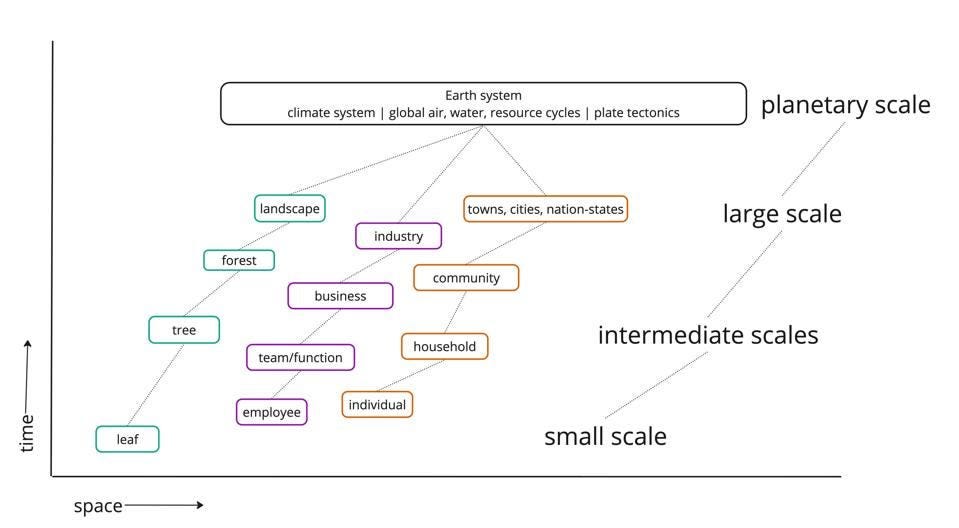
When we experience change, our capacity for renewal (instead of crisis) depends heavily on the health and maturity of the systems around us. Resilience science calls this “memory”: the reservoir of relationships, skills, and options held by higher-level systems. Former colleagues willing to recommend you, the college relationships you’ve maintained, or a community organization that offers practical support are all forms of memory you can draw on.
Consider your professional network. It may not be front of mind when you feel secure in your role, but the moment you lose a job, that same network becomes decisive. If relationships are strong, they can provide leads, introductions, and encouragement; if they are thin or neglected, renewal becomes a lonely, uphill climb. This is cross-scale interaction in action: an individual’s possibilities are shaped by the condition of the networks and communities just beyond them.
Healthy higher-scale systems expand the menu of renewal; fragile ones narrow it. A strong marriage can buffer a career collapse. A supportive community can soften the shock of relocation. But when multiple surrounding systems deteriorate at once, “memory” weakens, challenges cascade, and even the most talented can find themselves stuck. Resilience is not just personal toughness, but the quality of your connections with the wider society and environment.
Innovation From Within Your Identity
While support tends to flow from larger scales, innovation often emerges from below—from the components that make up your identity. You are not a single, fixed persona but a portfolio of roles, relationships, interests, and routines, each at a different stage of the adaptive cycle.
A cross-country move illustrates this dynamic. A senior leader might keep the same global role but still need to rebuild friendships, routines, and community ties. Each piece can renew independently, feeding fresh energy into the whole, and this modular renewal is healthy. The real danger arises when every domain—work, relationships, and community—undergoes major change at the same time, throwing an entire identity into crisis.
Imagine a COO who relocates for a promotion just as a long-term relationship ends. Suddenly, the familiar office, social circle, and support system are gone. What allowed her to recover was not grit alone. She tapped alumni connections for perspective, leaned on a mentor from a previous role, and deliberately invested in one “small” arena—joining a local running group—that became the seed of a new community. She did three things leaders can copy in any disruption: activated dormant networks, diversified daily roles, and chose one space for intentional renewal.
When dealing with change, many leaders fall into an optimization trap: clinging tightly to “the way things have always been.” In organizations, this looks like over-optimizing a business model until it becomes brittle; at the personal level, it looks like over-identifying with one role or success story. Resistance narrows vision and limits options. When change arrives—especially unexpected change—resistance can blind leaders to the possibility of new connection and new value creation.
Some of the best outcomes in our careers were not obvious at the outset. The role we eventually loved was rarely the one we first pursued after a layoff. The difficult relocation often opens doors we could not have imagined beforehand. The adaptive cycle encourages leaders to accept the inevitability of change and focus on renewal over resistance.
A Practical Playbook For Leaders
The adaptive cycle suggests several practical moves that leaders can start making now, before the next disruption hits.
Invest in relationships before crisis. Networks and communities function as higher-scale memory. They are resources you draw on when disruption arrives, not assets you can assemble overnight. Make a habit of nurturing weak ties, mentoring others, and staying in touch with former colleagues when things are going well.
Diversify your leadership identity. When everything rests on a single role or brand—“the turnaround CEO,” “the rainmaker”—disruption in that space becomes devastating. Multiple meaningful roles (leader, parent, board member, creator, community builder) give you redundancy and continuity when one area falters.
Practice small, intentional renewals. You do not need to overhaul your life all at once. Allowing parts of your professional and personal world to evolve—new skills, side projects, communities, or hobbies—prevents rigid optimization that makes future disruption more severe.
Stop fighting every change. Change is uncomfortable in part because it breaks connections that make us feel secure. Yet breaking connections also creates space for innovation. Resisting change at all costs can blind leaders to new opportunities, new partnerships, and new ways of creating value.
A simple reflection you can use today: think of a disruption you are currently facing—or one you see coming. Ask yourself three questions:
What higher-scale “memory” can I activate—networks, mentors, family, communities?
How diversified is my identity if this one role or success story changes dramatically?
Where is one small area I can intentionally renew in the next 30 days?
Don’t Wait For The Next Crisis
In the end, resilience is not about avoiding change. It is about building the diversity and “memory” that allow you to move through disruption well, so that when it arrives, renewal is not just possible, but genuinely meaningful.
For leaders, that is a long-term strategic advantage. Don’t wait for the next crisis. Start building that memory and diversity now.
For more on the adaptive cycle, check out the foundational article of the series.