

A few years ago, I walked into an engagement with a company that had just finished a climate scenario analysis with another advisory firm.
The analysis was thorough. Hundreds of sites assessed. Projections of future climate conditions under multiple warming scenarios, with physical risks quantified site by site. The invoice, I was told, ran to several hundred thousand dollars.
I sat down with management and asked what they’d done with it. There was a pause.
They’d prioritized sites for climate action based on which ones generated the most revenue. (Which means they didn’t use the hundred-thousand-dollar analysis.)
They already knew which sites mattered most to the business (revenue generation). The projections added nothing to that. The analysis had produced a mountain of impressive-looking output that management couldn’t act on, so they fell back on what they already understood.
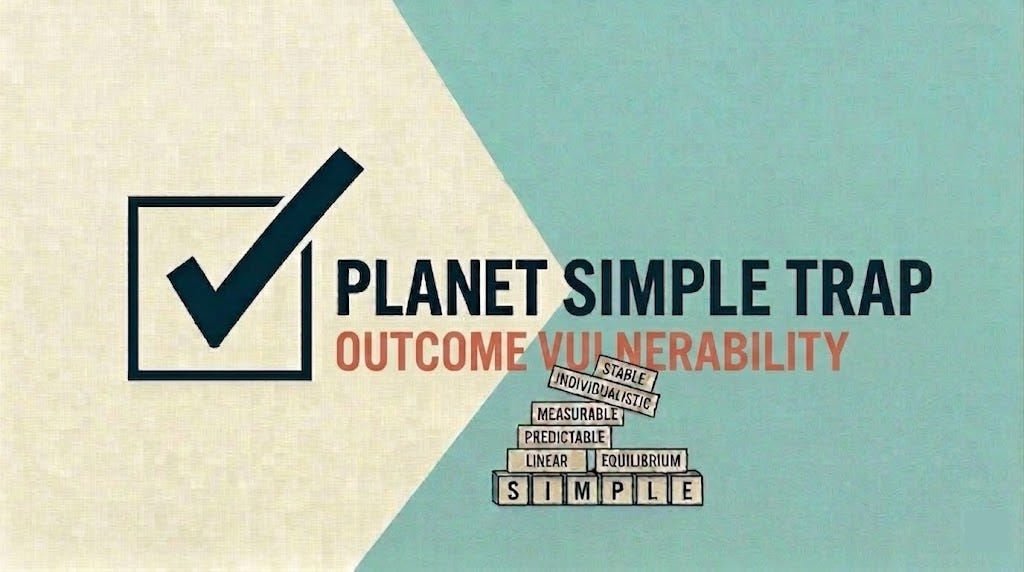
That has a name in climate adaptation science: outcome vulnerability. It’s one of the most common Planet Simple traps I run into, and one of the most expensive.
The assumption buried in the analysis
Outcome vulnerability starts with the climate model and works outward. The assumption is that projections of future physical conditions will reveal what needs to be done. Get the science right and the management decisions follow in Linear fashion (The L of Planet S-I-M-P-L-E).
It’s an appealing idea, and Planet Simple in its structure: establish the facts through rigorous research, and the answer will emerge.
But climate projections are generated at global or continental scales. They model physical variables (temperature, precipitation, sea level). The contextual factors that decide whether those changes matter for a specific business at a specific location sit outside the model.
The model knows nothing about the local infrastructure, the community dependencies, the regulatory context, the operational specifics. Outcome vulnerability assumes it doesn’t need to, that the projection is enough to drive the decision.
It rarely is.
The alternative
The approach that produces something you can act on is called contextual vulnerability assessment. It starts with the business context. What does this site actually do for the business? What vulnerabilities already exist in its operating environment? Which local factors (infrastructure, supply, community, regulation) drive its exposure to climate change?
The climate model becomes one input among many. The question to answer is: given what we know about this specific place, how might climate change affect our ability to operate here?
Which is exactly what the management team in my opening story was doing when they prioritized by revenue. They were reasoning from context. They just hadn’t called it that, and they hadn’t needed to spend several hundred thousand dollars to get there.
The illusion of certainty
There’s a deeper problem with outcome vulnerability, and it runs through this whole series: the illusion of certainty that quantitative analysis creates.
A table of projected physical risk scores for every site looks authoritative. The numbers imply precision.
But climate projections at the scale of a single industrial site carry a lot of uncertainty. And that uncertainty compounds when you translate a physical variable into a business impact.
So the false precision misleads. Management feels they’ve understood their climate risk because they’ve got a number for it. What they’ve actually got is a quantified non-answer to a slippery question.
Contextual vulnerability gives you something you can use: where your operations are genuinely exposed, why, and what that means for decisions you’re actually in a position to make.
That’s what a several-hundred-thousand-dollar engagement should deliver.
This is part of the Planet Simple Traps series, exploring the tools and frameworks that look rigorous but quietly reinforce the assumptions holding corporate sustainability back. Based on Leaving Planet Simple by Dr. Alex Gold.