

Two chefs run two kitchens.
The first tastes the soup at the pass, decides it needs more salt, and seasons the next batch heavier. Customer complaints drop. She’s learned something.
The second runs every service as an experiment. Before dinner she writes down what she expects: a longer sear at lower temperature should give her a more uniform crust. She controls the variables, tracks the outcome, and walks out of the kitchen knowing whether her theory of the protein held up.
Both chefs are learning from experience. Only the second is doing it on purpose.
This is the gap between incrementalism and adaptive management. An established mixup and one of the most pervasive Planet Simple traps I see in corporate sustainability.
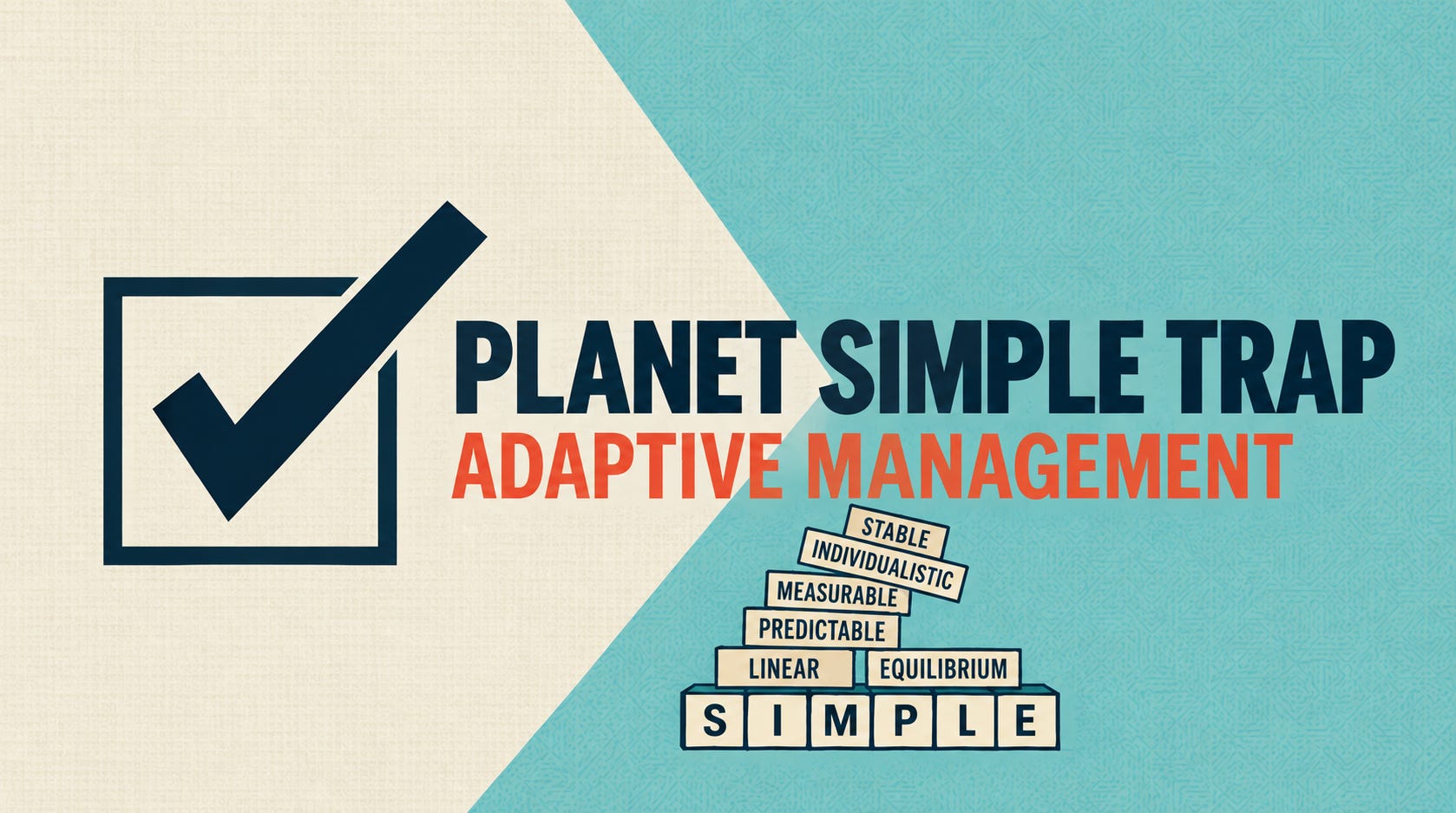
What adaptive management actually means
The term has a specific origin in natural resource management. Strategies get treated as hypotheses. Outcomes get monitored against explicit expectations. Deviations get interrogated, because the deviation is the data.
The point of the exercise is to build a better model of the system you’re managing, so the next decision is sharper than the last. Management starts behaving like science. You’re running an experiment, and updating your view of the world based on what you find.
That’s incompatible with Planet Simple, which expects certainty up front. On Planet Simple, you do the comprehensive analysis, then act. The back end (appraisal, evaluation, lessons fed into future decisions) is an afterthought. Why spend money on ineffiencient “compliance” activities when you already know what the outcome will be?
What incrementalism actually looks like
Take Boskalis, a multinational maritime services company. Its 2021 sustainability report has a section headed “Adaptive management.” It describes monitoring environmental performance and adapting working methods as necessary.
That’s incrementalism. There’s no statement of what the company is trying to learn. No mention of uncertainty. No evidence that outcomes are being compared against anything explicit. It’s feedback and adjustment with a scientific label stuck on top.
What separates the genuine version is intentionality about learning. You name what you expect before you act. You check what you got afterwards. Learning becomes something the organization is designed to produce.
Why this matters now
Companies are operating inside genuinely novel problems: climate change, biodiversity loss, social disruption. The knowledge base is moving fast. The cost of getting strategy wrong is high.
An organization that can treat its sustainability work as a series of experiments, and can tell the difference between “we did this and it worked” and “we did this and we know why it worked,” is building real organizational knowledge about how to operate on Planet Earth.
The right question to ask of any sustainability program is: what were you trying to learn, and what did you find out? Everyone says they’re learning. Few can answer that.
If there’s no good answer, you’re muddling through.
This is part of the Planet Simple Traps series, exploring the tools and frameworks that look rigorous but quietly reinforce the assumptions holding corporate sustainability back. Based on Leaving Planet Simple by Dr. Alex Gold.