

There’s a standard way physical therapists measure recovery after knee surgery. They track how quickly the patient regains range of motion, how fast the swelling goes down, how soon they’re walking without assistance. The faster the return to baseline, the better the recovery. The whole goal of rehabilitation, by this measure, is to get the patient back to exactly where they were before the injury as quickly as possible.
That definition of recovery makes sense for a knee. It makes much less sense for an organization navigating a destabilizing world.
But it’s the definition of resilience that most businesses are working with. And it’s a Planet Simple trap.
Two Kinds of Resilience
The concept of resilience entered scientific literature through the work of ecologist C.S. Holling over fifty years ago. Since then, it’s split in two directions that look superficially similar but lead to fundamentally different outcomes.
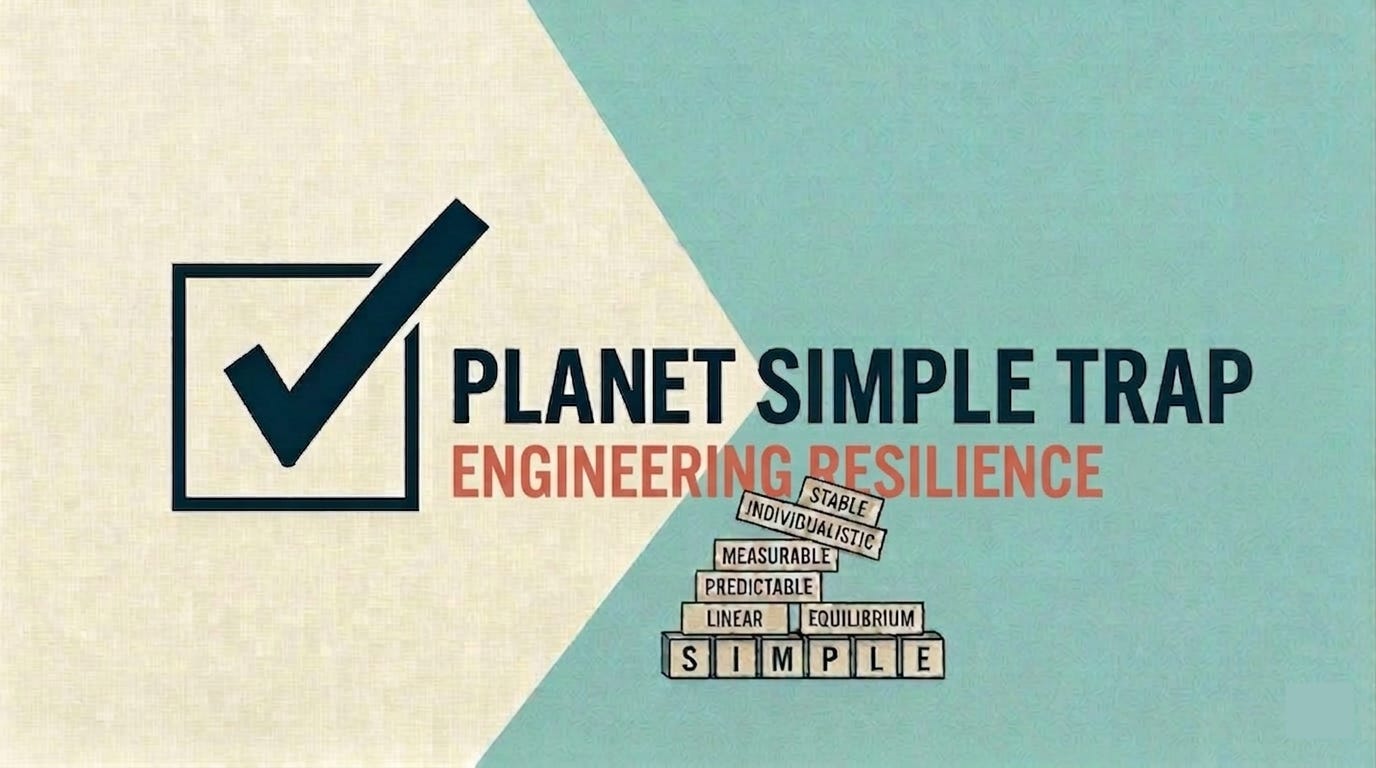
The first is engineering resilience: the ability to bounce back after a disruption, with faster return to the original state signaling greater resilience. A bridge that doesn’t sway in a storm. A supply chain that recovers in two weeks instead of six. A system that resists change and returns to its prior configuration.
The second is evolutionary resilience: the capacity not just to absorb disruption but to reorganize, adapt, and emerge differently on the other side – in ways that may be better suited to the changed conditions. This version of resilience doesn’t measure success by how quickly you return to the original state. It measures success by how well you navigate to a viable new one.
These aren’t subtly different. They point in opposite directions. Engineering resilience is about resisting change. Evolutionary resilience is about working with it.
Why Engineering Resilience Dominates (and Why That’s a Problem)
Engineering resilience is intuitive to managers raised on Planet Simple. It aligns with the core objective of maintaining stability and control. It’s also easier to measure. Bounce-back time is quantifiable. The capacity to reorganize into a better configuration is not, at least not in advance.
The problem is that engineering resilience, pursued consistently, produces the same outcome as the ultimate Planet Simple trap: a system that’s increasingly tightly optimized and increasingly brittle. A system that is good at bouncing back from predictable disruptions but fundamentally unprepared for the disruption that changes the landscape entirely.
Resilience scientist Lance Gunderson put it directly: engineering resilience “relies on an implicit assumption of global stability” – i.e. the idea that there is one equilibrium to return to. Evolutionary resilience acknowledges that the disruption might mean the old equilibrium no longer exists.
What This Looks Like in Practice
A company whose supply chain was disrupted by COVID-19 and responded by building in more inventory buffer and adding backup suppliers has improved its engineering resilience. It’s better positioned to absorb the same disruption next time.
A company that used the same disruption to fundamentally question its sourcing model - exploring regional supply chains, reassessing which inputs it actually needs, reconsidering the geography of its operations – is working toward evolutionary resilience. It’s not just absorbing the disruption; it’s using it as information about how the world has changed.
Most companies did the former. It was faster, more measurable, and didn’t require questioning any foundational assumptions. That’s exactly the pattern to watch for.
The Question That Changes Everything
Next time you hear a company describe itself as “resilient,” it’s worth asking: resilient to what, and in which direction?
A knee that bounces back quickly is a success. An organization that bounces back to the same configuration that made it vulnerable is an accident waiting to happen again.
This post is part of the Planet Simple Traps series, based on the book Leaving Planet Simple by Dr. Alex Gold. More at dralexgold.com.