

I often ask people to imagine a planet designed for human convenience (great party trick, I know). A planet where nature is stable and predictable. Where cause leads reliably to effect – every time. Where complex problems can always be broken into discrete parts, and then built back up to be solved. Where the planet is a setting for economic activity (the backdrop, stage, prop) rather than the system that makes it possible.
That planet doesn’t exist. But we think we’re living in it.
I call it Planet Simple.
The name comes from an acronym that captures its defining assumptions: Stable, Individualistic, Measurable, Predictable, Linear, and at Equilibrium. A set of beliefs about the world that trace back to the Scientific Revolution and still quietly govern how most organizations think about risk, strategy, and sustainability today. The assumptions are deeply embedded.
Our businesses, our institutions, our entire model of economic life are constructed on this worldview, which contemporary science has since disproved. Sustainability was meant to be the correction. Instead, it got built into the existing structure – reinforcing the foundation rather than replacing it.
The result is what I call Planet Simple traps — ways that corporate sustainability gets distorted by the very mindset it’s supposed to challenge.
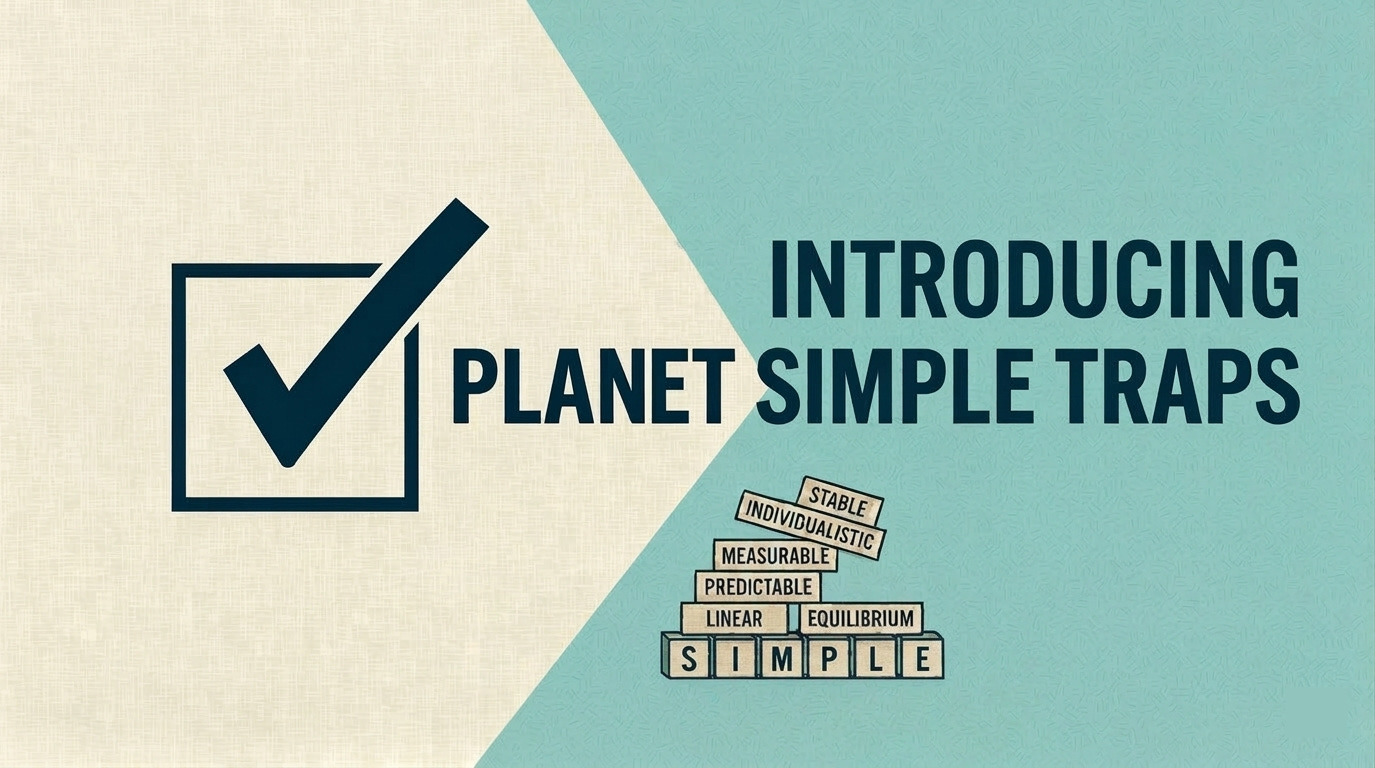
A Planet Simple trap doesn’t look like failure from the outside. It looks like progress:
A company publishes a CSR report with all its good deeds.
A risk team completes a climate scenario analysis.
A company surveys its stakeholders to identify material issues.
All the boxes are checked. None of the underlying assumptions have changed. That’s the trap!
The traps aren’t signs of bad faith. Most of the organizations falling into them are trying to do the right thing. The problem is that they’re trying to do the right thing using the wrong mental model — one that was never designed to handle systemic, nonlinear, deeply uncertain global challenges. You can’t manage a complex adaptive system with tools built for a world of equilibrium and control.
I know this pattern well because I’ve lived it. I’ve been embedded in public and private sector organizations tasked with integrating sustainability into strategic planning. Every time, the barriers aren’t a lack of knowledge or willingness — they were structural. They were Planet Simple at work.
My experience was the basis for Leaving Planet Simple — and now this series. All in the hope of laying the groundwork for a better future.
Over the coming posts, I’ll walk through ten specific Planet Simple traps, drawn from the research and case studies in Leaving Planet Simple. Each one distorts a genuine method — resilience, scenario analysis, materiality, reporting — by fitting it into an existing Planet Simple framework rather than allowing the method to challenge that framework. Each one allows practitioners to claim they are doing sustainability while preserving the assumptions that gave rise to today’s global challenges in the first place.
The ten traps (in no particular order) are:
Corporate Social Responsibility: how the cleanup strategy became the strategy
Engineering Resilience: the definition of resilience that makes your organization more fragile
Outcome Vulnerability: why more climate data doesn’t mean better decisions
Scenario Analysis or Sensitivity Analysis: the difference that most companies miss
Adaptive Management or Incrementalism: when learning from experience is just muddling through
The Double Materiality Matrix: what’s wrong with putting sustainability issues in a box
The Most Likely Scenario: why identifying it sets your strategy up to fail
Aggregating Climate Risk: the averaging that produces the wrong answer by design
Substituting Means for Ends: when the analysis becomes the destination
The Ultimate Trap of Planet Simple: why optimizing a system is the surest way to break it
You don’t need to be a sustainability professional to follow this series. If you’re a business leader who senses that something is off about the current sustainability conversation, i.e. that there’s a lot of activity but not enough transformation, this series is for you.
The alternative way of seeing this has always been there. Let’s find it.
This post is part of the Planet Simple Traps series, based on the book Leaving Planet Simple by Dr. Alex Gold.