

Most people who use AI have had some version of this experience.
You ask the system something. It gives you an articulate, confident answer. Something about it doesn’t sit right. You push back. The system apologizes and re-explains. The new answer is also wrong. By the third round you notice that the system doesn’t seem to know what it doesn’t know. It also doesn’t quite seem to know what it just said.
The standard reading of this is that AI is good at fluency and bad at accuracy, and that accuracy will improve over time. That reading is incomplete. Underneath AI is a particular mode of thinking that is known to have shortcomings in the real world. Understanding its limitations, even as it comes to dominate the knowledge economy, will help us work better with AI now that it is here to stay.
That’s the objective of this series. I’m going to develop it across five articles, drawing on the work of Iain McGilchrist – a psychiatrist, neuroscience researcher, and philosopher. His book The Master and His Emissary argues that the two hemispheres of the brain represent two ways of attending to the world: the right hemisphere as the Master, taking in the whole; the left hemisphere as the Emissary, focused, narrow, instrumental, and (importantly) the hemisphere where language lives. The two are meant to work together, with the Master in charge. McGilchrist’s claim is that over centuries the Emissary has quietly taken over the Master’s role. The left-hemisphere mode of attention has become our cultural default, and its partial way of attending to the world is responsible for many of the social, environmental, and economic problems we now face. AI, I’ll argue, is the latest and most powerful expression of this drift.
McGilchrist himself, on what is happening now:
“I believe that we have entered a phase of cultural history in which negative feedback between the products of action of the two hemispheres has given way to positive feedback in favour of the left hemisphere. Despite the primacy of the right hemisphere, it is the left hemisphere that has all the cards and, from this standpoint, looks set to win the game.”
Iain McGilchrist, The Master and His Emissary, p. 232
This article explains the diagnosis. The next three develop specific aspects of it. The fifth turns the argument over and asks what humans actually have to bring to AI-assisted work, which is something I believe practitioners have found hard to articulate. McGilchrist’s thesis provides a framework to help.
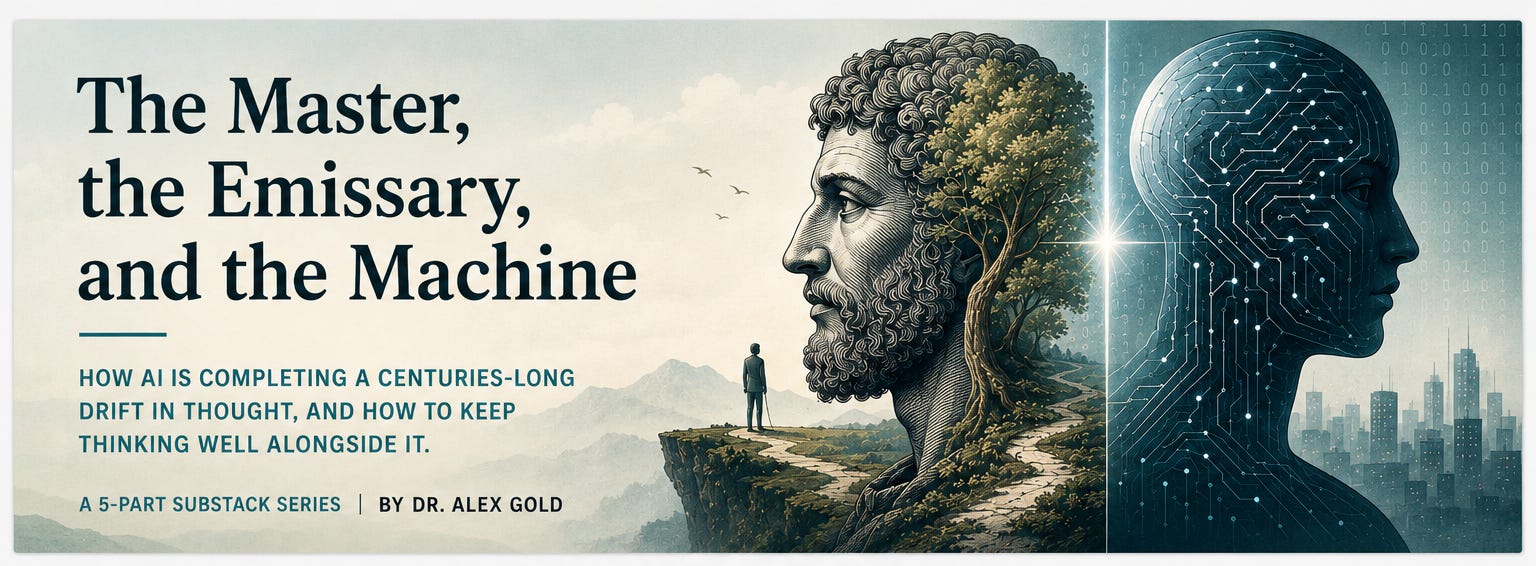
The series:
1. The Diagnosis: AI as the Emissary’s Triumph (this article)
2. The Structure: Decontextualization and the Loss of the Whole
3. The Unsaid: Language-Dependence and the Loss of the Tacit
4. The Author: Misplaced Confidence and the Loss of Accountability
5. The Human Stance: What “Human in the Loop” Should Actually Mean
A note on why I’m writing this, and why it’s worth staying with me through the depths of McGilchrist’s thinking.
I’ve spent years in sustainability strategy. Strip away the surface descriptions of going green and ESG, and the work is something more structural: shifting the mindset of business toward long-term value, and toward recognizing that long-term value depends on a prosperous society and a healthy environment. The work has, among other things, been a long apprenticeship in noticing when a prevailing way of thinking has stopped serving the problem it is supposed to solve. The categories don’t fit. The measurements miss the thing that matters. McGilchrist, when I first read him, named what I had been recognizing in fragments for years. He gave it a vocabulary that runs underneath the surface-level problems and shows them all to be expressions of the same older pattern. The pattern is now showing up in AI. That’s what I want to write about.
An older argument made new
McGilchrist’s book is long, but the case he is making is straightforward.
Pop psychology talks about left brain (logic) and right brain (creativity). McGilchrist sets the record straight. He explains how the two hemispheres are two ways of attending to the world. The left hemisphere attends in a narrow, focused, instrumental, reductionist way: this thing, in front of me, what it is for, how I can use it. The right hemisphere attends in a broad, open, vigilant way: the whole field, what is here, what might be coming, what this thing is in the context of everything around it.
Both modes matter. Neither alone is enough. McGilchrist’s claim is that they are designed to work together, with the broad attention (right hemisphere) doing the foundational work of registering reality as it actually is, and the narrow attention (left hemisphere) doing the useful work of acting on that registration.
He has a fable for this. The master is the right hemisphere. He sees the whole picture. He needs an emissary, a left hemisphere, to go out and do specific work on his behalf: build the tool, dissect the food, negotiate with the village. Language is the emissary’s medium; he is the one who speaks, who names, who articulates. The emissary is excellent at this kind of work; that’s what he was appointed for. The trouble starts when the emissary, having gained competence and confidence in his narrow domain, decides he no longer needs the master. He thinks he sees the whole picture. He doesn’t. But because he is the one who speaks, who plans, who acts, his version of the world is the one that gets externalized. The master, who actually sees the whole, is squeezed out of the conversation.
That is the long arc of McGilchrist’s argument. The emissary has been gradually taking over the master’s role in our culture for at least several centuries. You can trace it through the Enlightenment, through the rise of mechanistic science, through the bureaucratization of modern life, through the substitution of quantification for qualification in almost every domain we touch. The mode of attention that says “everything is analyzable into constituent parts, and everything can be put back together from those parts” has become the default way of seeing. The mode of attention that says “things are whole, situated, alive, in relationship” has been demoted to “intuition” or “feelings” or whatever else can be safely set aside.
McGilchrist values the left hemisphere; he is clear that it does necessary work and that humanity has built enormous things on it. His worry is that the emissary cannot do its job well without the master, largely because the emissary has no way of knowing what it is missing. The narrow attention is unaware of what it does not know. (Nobel laureate Daniel Kahneman described this as WYSIATI – What You See Is All There Is). When the emissary takes over, the world it brings into being is the world as the left hemisphere sees it: thinner, more impoverished, more reduced than the world that is actually there.
This argument lands differently depending on what you care about. McGilchrist himself has written about it in the contexts of mental health, philosophy, art, economics, politics, and the natural sciences. I came to it through sustainability work, where the missing right hemisphere shows up as the assumption that futures can be modeled and forecasted with confidence, that universal best practices can be deduced that will work regardless of context, that complex strategic decisions can be reduced to dashboards and benchmarks without losing what they were measuring. You have probably encountered the same drift in your own field, under a different name.
AI, particularly the large language models that have become the public face of it, is the latest and most powerful instance of this drift to left-hemisphere dominance. AI is the emissary’s mode of attention made into infrastructure. It is the left hemisphere’s worldview cast in code and given to all of us as a tool. AI is useful because it puts the emissary’s narrow attention to work at speed and scale. It is dangerous because it believes that What It Sees Is All There Is.
AI as the emissary’s triumph
A short version of the thesis before I get into specifics.
The basis of generative AI – large language models (LLMs) – are a particular mode of thought, scaled and made universally available. The framing of LLMs as a neutral new tool, like spreadsheets or word processors, gets the situation wrong. The way an LLM processes language, the things it pays attention to, the things it cannot pay attention to, the kind of output it produces, the kind of confidence it has in that output: all of these are recognizable, point by point, as the operations McGilchrist describes the left hemisphere performing.
Three traits make the family resemblance clear. I’ll introduce all three here. Each gets a full article of its own in the series, with examples drawn from real work.
The first trait: literal compliance, faithful misreading
The deepest of the three is what I’ll call decontextualization. The AI processes the literal content of what it is given, without access to the layers of convention, structure, and reading practice that make that content mean what it means in the world it came from. The map without the territory. The territory was never what the AI was given to work with.
Here is a briefing of the example that article two will dissect in detail. I recently worked on a benchmarking project that ran AI extraction across hundreds of European corporate sustainability reports. The system was asked to extract climate targets. One company’s full extracted disclosure read: “See page 91 for details on our climate targets.” The actual targets, on page 91, were nowhere in the extracted dataset.
To a human reader, this is absurd. Anyone who has opened a document knows that “see page 91” is just a pointer. The content lives on page 91; the sentence directs you to it. But to the AI, the sentence is what it was given. The pointer-versus-content distinction lives in how documents work. The tokens themselves don’t carry it. The AI has no way to access the distinction from the text alone.
That is the shape of the trait. The AI complies literally with what it was asked to do. It misreads the meaning faithfully. And the misreading is invisible from inside the AI, because the AI has no felt sense of what the text is supposed to do in the world it came from.
Article two will develop a more painful version of this trait that affected the benchmarking of 26 European companies in the same dataset. The point for now is to register how this trait shows up in AI-assisted work.
The second trait: the world cannot be put in a prompt
The second trait is language-dependence. LLMs operate on language. By design, they cannot operate on anything else.
There is a great deal that experienced practitioners know that does not live in language. The senior advisor’s feel for a client. The editor’s sense that a piece of writing is “off” before they can say why. The craftsperson’s hand. The way you read a room, a meeting, a relationship, a mood. A particular community’s unwritten conventions. Polanyi called this tacit knowledge: the kind of knowing that resists articulation even when you try to articulate it.
AI cannot reach any of it. Tacit knowing lives outside language by definition. An LLM working from text is operating on the explicit layer. The implicit layer, where most of expert work actually lives, is unavailable. This is a structural limit, not a technological one. No improvement in AI changes the fact that tacit knowing is, by definition, what has not been put into words.
The result, when AI starts contributing to expert work, is that the explicit crowds out the tacit. Only the explicit can be processed, and what is processed becomes what counts. The same shift McGilchrist describes happening across centuries of cultural history now happens inside individual work products on the order of minutes.
Article three will show you what this looks like, using a piece of analysis I produced where the AI was fluent, articulate, and missed the two things any experienced consultant would have caught on first read.
The third trait: fluency without accountability
The third trait is misplaced confidence and lack of accountability.
The surface symptom is familiar. AI is often confidently wrong, and the confidence doesn’t soften when challenged. Push back on an output, and the AI apologizes, then produces a confident new answer that’s also wrong, then apologizes again. By the fourth iteration you realize the thing has no internal sense of where it stands. Worse yet, it doesn’t seem to care.
McGilchrist would point out that we are looking at the absence of a particular kind of right-hemisphere check: the felt sense of “does this match the world that is actually there.” The left hemisphere, in his account, is “expert at pretending” to understand what it doesn’t, at producing “quite plausible, but bogus, explanations for the evidence that does not fit its version of events.” (His words, page 234.) Elsewhere he describes the left hemisphere as “a conformist, largely indifferent to discrepancies” (page 235). That indifference is what allows the confidence: nothing in the system registers when the output and the world have come apart. The AI does this by design, and it does not have access to a right-hemisphere check.
The deeper problem is the consequences of its false confidence. The AI has no stake. It is not answerable to anyone. It has no continuous first-person relationship to what it has produced. When a chart it just drew is shown to be wrong, the AI cannot quite acknowledge having drawn it; it talks about its own output as if it were external, something it is now commenting on. Article four will show you exactly what that looks like. The pattern is so fundamental that it has a direct parallel in the neurological condition McGilchrist discusses elsewhere in the book, in patients with damage to the right hemisphere.
Three traits. Decontextualization, language-dependence, misplaced confidence. Each gets an article of its own. Together they make up what I think of as the emissary’s signature, now scaled to global technology we use every day.
What comes next
McGilchrist, near the end of The Master and His Emissary, says something about how to address the patterns he diagnoses. Piecemeal corrections matter, but they will not, on their own, do what needs doing. What needs doing, he writes, is “opening our eyes to the limitations of the view of the world which underlies them, the view which, as a society, we appear to adopt as our default.”
That is the aim of the four articles that follow.
Article two takes the first trait, decontextualization, and shows it in action through the reporting benchmarking project that produced the cross-reference example above. Article three takes the second trait through a piece of analysis I produced where the data was right and the voice was wrong. Article four takes the third trait through an AI exchange that, once you see what it is doing, is frustrating to watch. Article five turns the argument over and says what the human contribution to AI-assisted work actually is, given everything the first four articles establish.
The series:
1. The Diagnosis: AI as the Emissary’s Triumph (this article)
2. The Structure: Decontextualization and the Loss of the Whole
3. The Unsaid: Language-Dependence and the Loss of the Tacit
4. The Author: Misplaced Confidence and the Loss of Accountability
5. The Human Stance: What “Human in the Loop” Should Actually Mean
The series is called The Master, the Emissary, and the Machine. Although the machine (AI) is new; the drift that brought us here is centuries old. Let’s unpack what this means and how to address it.