

“The existence of a system of thought dependent on language automatically devalues whatever cannot be expressed in language; the process of reasoning discounts whatever cannot be reached by reasoning.”
Iain McGilchrist, The Master and His Emissary, p. 229

The series:
1. The Diagnosis: AI as the Emissary’s Triumph
2. The Structure: Decontextualization and the Loss of the Whole
3. The Unsaid: Language-Dependence and the Loss of the Tacit (this article)
4. The Author: Misplaced Confidence and the Loss of Accountability
5. The Human Stance: What “Human in the Loop” Should Actually Mean
A while back, I asked an AI to help me analyze a set of disclosures about adequate wages. The analysis was for a publication read by sustainability professionals, the same firms whose disclosures were being analyzed, who are also potentially clients.
The data was straightforward. Of about 100 companies I was looking at, a third made adequate wage commitments with substantive detail (specific living wage benchmarks, third-party validation, scope of coverage). A third made surface-level commitments that did not really say anything. A third were silent on the topic altogether.
The AI returned exactly what I asked for. The analysis was accurate, the categorization was crisp, the prose was articulate. The data points lined up. The argument flowed.
I read it once and felt something was off. I could not immediately say what.
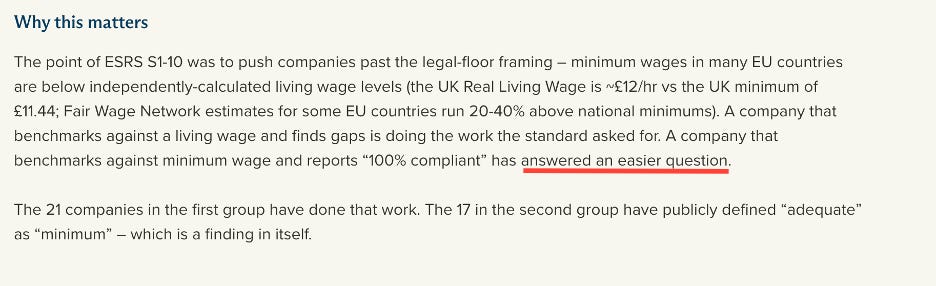

Reading it a second time, slowly, I saw it.
The AI had used phrases like “answered an easier question,” “fall short of that requirement,” and implied many companies didn’t do the work the standard asked for. It had labeled the third group of companies, the ones that said nothing, as the “silent majority.”
At the start of my career, I probably would have been ok with the phrases – they are accurate. Now that I’ve built a brand and business in sustainability consulting – where trust and relationships are paramount – I cringe at the thought of my clients reading these words.
The first issue: tonal register
The first issue is the tonal register. “Answered an easier question” is the kind of thing you say about someone, not with them. It is the language of a journalist or an academic critic, not a consultant trying to earn trust with clients. Same with “fall short of that requirement” and assuming the companies haven’t tried to meet the requirements of the standard. Each one reads as a critique from outside the field. In a sustainability publication read by practitioners and the firms they advise, that tone lands as scolding. It puts the writer in the position of judge over the firms whose disclosures are being analyzed, many of whom are clients, partners, or peer organizations. Sharp analytical prose works fine in journalism. In a consulting publication, it sounds like preaching.
A consultant who understands the reality of corporate sustainability speaks differently. Varied practices fall along a maturity curve – many companies are starting out, rather than being moral failures. We want to use language that describes a stage in a journey rather than a deficiency. “Earlier in the process.” “Not yet at the level of substantive commitment.” “The work has yet to be developed in the detail the standard envisions.” Same data, different posture toward the reader. What changes is whether the reader receives the analysis as something they can work with or something they are being scolded for.
The second issue: a phrase misused
The second issue is the misuse of “silent majority.” A silent majority is not a group that says nothing. It is a group that is present in the discussion, that may even be the largest constituency, that does not make its position substantively known.
The companies that AI had labeled as the “silent majority” were not silent. They were a mix of companies with no content on adequate wages and companies with brief statements about adequate wages.
The AI had collapsed a distinction that practitioners would never collapse. A company that says nothing about adequate wages is a company that has deemed the issue not material to its business (and so the company is permitted to omit the content from its report). That is a meaningful position. It is a different position from a company that includes something on adequate wages, even if what it includes is broad and unsubstantive (“we pay an adequate wage” with no further detail). The first group is making an assessment: this issue is not material to us. The second group is making a claim without substance. Lumping them together under “silent majority” or any other single label flattens a critical distinction that informed readers would make.
What I sent back to the AI was a correction. Not a full rewrite, but an indication of what needed to change. Soften the tone. Treat absence as its own category, distinct from any disclosure. The “silent majority” label, if it was used at all, should refer specifically to companies present in the discussion but with broad, undeveloped statements. The companies that disclosed nothing on the relevant standard should be categorized as having made an assessment of non-materiality.
The AI did the rewrite. It was accurate, articulate, and something an experienced consultant can stand by.
The third issue: a regulatory reality the AI cannot see
The third issue is harder to spot because it lives in the world around the disclosures, not in the prose itself. The AI read words like “requirements” and “standards” and treated them at face value. It had no way to know what those words mean in practice at this particular moment.
The companies publishing these reports are in their first reporting cycles under the new standards. Regulators have publicly stated that the early years are about capability-building, not punishment. Auditors are issuing assurance opinions on disclosures that practitioners know are falling short of the substantive intent of the standard. The requirements exist on paper. In practice, what gets through is much softer than the text would suggest.
This is not cynicism, and it is not a critique of the regulators or assurance providers. It is a deliberate stance from the regulatory community: bring companies along, let the disclosure quality improve over the next several cycles, save enforcement for when the field has matured. The practitioner reading these reports knows this. They calibrate their tone, their criticism, and their framing accordingly. They would not describe a disclosure as “falling short of that requirement” in this moment, because the requirement, as it is being applied right now, is softer than that language implies.
The AI does not know any of it. It reads “the company has not met the requirement” as a hard statement of failure. It sees “fall short” as a binary diagnosis. The fact that the regulator is, right now, holding the door open for these same companies to improve over time and not penalizing them for not having done it yet is not in the tokens. It is in today’s context.
When the AI in the adequate wages analysis produced the language of “fall short of that requirement,” it was doing what its training data tells it to do: take the requirement as fixed, take the disclosure as measurable against it, produce the verdict. The practitioner reading the same data sees a soft regulatory moment, sees companies in the early stages of building their disclosure practice, and sees the field-level work as one of capability-building rather than judgment.
The trait at work
This is the second trait the series is diagnosing - language-dependence.
LLMs operate on language. By construction, they cannot operate on anything else.
There is a great deal that experienced practitioners know that is not in any text. The senior advisor’s feel for a client. The editor’s sense that a piece of writing is “off” before they can say why. The consultant’s read of a tonal register that will land wrong in a particular audience. The intuition that “silent majority” has connotations the AI did not compute. The situated knowledge that a regulator’s “requirement” is softer in practice than it sounds in text.
All of this is what Polanyi called tacit knowledge: the kind of knowing that lives in the practitioner, that develops over years of practice, that resists articulation even when you try to articulate it. The classic Polanyi example is bicycle riding, a skill anyone with practice can perform, none of us can teach by explanation, all of us know we have. Tacit knowledge is what we know that we cannot say.
McGilchrist’s frame for this is in the introductory quote above:
“The existence of a system of thought dependent on language automatically devalues whatever cannot be expressed in language; the process of reasoning discounts whatever cannot be reached by reasoning.”
What is capable of being spoken becomes what counts. What is not spoken quietly disappears.
A structural limit, not a technological one
I want to make a strong claim here, because the rest of the article depends on it: AI’s discounting of the tacit is structural. It is the wrong medium to hold this kind of knowledge.
Tacit knowing lives in practitioners, in their bodies, in the years of doing the work and watching what comes back. An AI working from text is operating on the layer where the tacit is not. Better text will not reach the tacit. The tacit, by definition, has not been put into text. That is what makes it tacit.
Some readers will object that AI will eventually solve this through multimodal models, embodied training, or larger context windows. I think this is the wrong way to think about the limit. As soon as something has been articulated, written, captured, recorded, it has moved from the tacit layer to the explicit one. Anything an AI can process is, by definition, no longer tacit. What stays tacit is what has not yet been put into form. There is no AI roadmap to reach what has not been put into form, because the moment you put it into form, it is no longer there. The tacit is a category of knowing that AI is structurally on the wrong side of. Calling it a stage AI has not reached mistakes reality.
There is a second objection worth answering: if tacit knowledge cannot be articulated, does it matter? It matters because the tacit is not residual to expertise; it is what expertise is. Tacit knowing is experiential by nature, intangible by definition, and hardwired into the practice of skilled work. It cannot be optimized into code or text and done away with without losing what makes an expert an expert. The fact that it resists articulation is precisely why it carries the weight it does.
This matters for how we think about working with AI. If the tacit were a stage AI has not reached, the right move would be to wait, to use AI lightly for now and more deeply later. If the tacit is what AI is structurally on the wrong side of, the right move is to recognize that some of the work in expert practice will always need to come from the human side. AI use does not gradually approach handling the tacit. AI use grows, and the human responsibility for the tacit becomes more important, not less. Article five takes that responsibility seriously and develops a framework for it.
What this looked like in practice
The adequate wages is one piece of analysis, giving rise to three specific issues. But it shows what language-dependence does to expert work.
Notice what did not go wrong. The data was right. The AI distinguished between adequate wage disclosures and other remuneration-related content. The argument was logically sound. If you wanted to be uncharitable to me as the writer, you could say I was being overly picky. The piece was good enough. Most readers would not have noticed.
That is the trap. Most readers would not have noticed. But the readers who matter, the ones who actually read sustainability publications, who work in this field, who would be the ones whose engagement we wanted, would have noticed. Maybe not consciously. Maybe they would have just felt mildly judged and put the piece down. Maybe they would have read it but felt their trust in the writer drop by a degree. Maybe a specific phrase would have stuck in their head for the wrong reason. The piece would have done less of the work it was supposed to do, and the reasons would have been hard to articulate from the outside.
This is what the loss of the tacit looks like in expert work. The output is articulate. The data is right. The structural elements of competence are all in place. And the thing that makes expert work actually land, the sense that “this person understands my challenge and I can trust them to guide me correctly”, is missing. Because deploying tacit knowledge is the defining mark of an expert, the obvious absence of tacit knowledge in a piece of work quietly erodes the expert’s credibility with the readers who would otherwise have trusted it.
The right-hemisphere counterpart
McGilchrist’s right hemisphere is, among other things, the seat of tacit knowing. He returns to this throughout the book, often through Polanyi:
“We resort to explicit analysis of the process only when we introspect on what happened, either because something has gone wrong, or because we are complete beginners.”
The Master and His Emissary, p. 223 (quoting Dreyfus on Polanyi)
Explicit analysis is what we do when something is wrong, or when we have not yet learned the skill. The skilled practitioner, doing the work well, is operating tacitly. The right hemisphere holds this kind of knowing. The left hemisphere does the useful work of analysis when analysis is needed. Healthy cognition has both.
When the left hemisphere takes over, or, in this case, when a system that operates entirely on the articulated layer takes over, the tacit disappears. The tacit cannot be argued with; it can only be processed out. The system does not engage with the tacit; the tacit is simply unreachable. The articulated is what gets manipulated, multiplied, broadcast, used as raw material for the next round of articulated output. The tacit, which has not been articulated, drops out.
I think this is the deeper claim worth making explicit. AI’s operation, at scale, actively crowds out tacit knowledge. It erodes the substrate on which our collective expertise depends. Practitioners who started developing tacit knowledge over years of practice now find AI doing the surface-level production faster than they can. The motivation to do the slow, deep, embodied work of developing the tacit drops.
McGilchrist writes about exactly this dynamic at the cultural level:
“As a culture, we would come to discard tacit forms of knowing altogether. There would be a remarkable difficulty in understanding non-explicit meaning, and a downgrading of non-verbal, non-explicit communication.”
The Master and His Emissary, p. 433
That is the prediction. The conditional, “would come to discard,” reads as prophecy now landing. The cultural shift McGilchrist describes is arriving on a faster timescale than the centuries he was tracking. We are watching it happen inside our own work, inside our own organizations, inside our own practice, on the order of months.
What this asks of practitioners
A short closing note on what the trait implies for how we use AI.
The practical problem is not that AI gives bad advice. It often gives good advice. The problem is that the advice it gives lives on the explicit layer, and the work of integrating that advice with the situated, felt, tacit knowledge of the practitioner is the work AI cannot do. If the practitioner does the integration, the advice is useful. If the practitioner outsources the integration, just takes the AI’s output and runs with it, the work is degraded in a way that is hard to see from outside.
This puts the burden of the tacit squarely on the practitioner. The faculty being asked for is the slow, embodied, hard-to-articulate kind of knowing that takes years to develop. AI cannot supply it.
The risk (and this is what makes article five’s framework necessary) is that practitioners fail to recognize the importance of their contributions. AI is fast and articulate. The output sounds confident, regardless of what is behind it. The path of least resistance is to use what it produces. The practitioner who insists on doing the tacit integration anyway is going slower than the practitioner who does not. The slower practitioner is producing better work, but the difference takes a while to show up. By the time it does, the patterns of less-careful AI use have become habitual.
Article four takes the third trait, misplaced confidence and the loss of accountability, through an AI exchange that, once you see what it is doing, is frustrating to watch. Article five turns to the constructive question of what the human contribution actually is, given the limitations the first four articles establish.