

“The broader picture would in any case be disregarded, because it would lack the appearance of clarity and certainty which the left hemisphere craves. In general, the ‘bits’ of anything, the parts into which it could be disassembled, would come to seem more important, more likely to lead to knowledge and understanding, than the whole, which would come to be seen as no more than the sum of the parts.”
Iain McGilchrist, The Master and His Emissary, p. 428

The series:
1. The Diagnosis: AI as the Emissary’s Triumph
2. The Structure: Decontextualization and the Loss of the Whole (this article)
3. The Unsaid: Language-Dependence and the Loss of the Tacit
4. The Author: Misplaced Confidence and the Loss of Accountability
5. The Human Stance: What “Human in the Loop” Should Actually Mean
I recently worked on a benchmarking project that ran AI extraction across hundreds of European corporate sustainability reports. The goal was modest: pull out each company’s stated climate targets, organize them, and compare across the dataset to give readers a sense of where peers stood. The exact kind of work we are sold AI on.
The first time we ran the extraction, the Ørsted entry came back like this:
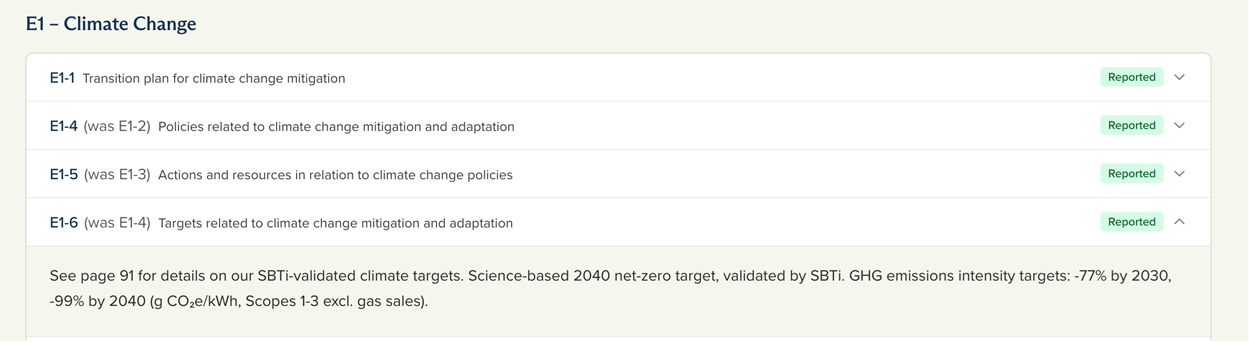
Any human who knows how to read can see what is wrong here. The sentence “see page 91” is a direction. The actual targets, the substantive content, live on page 91. What the AI extracted is the pointer that directs you there.
But the AI could not tell the difference. From its position, the sentence was a string of tokens. The token “see” was followed by the tokens “page 91” followed by the tokens “for details on our climate targets.” It looked, on the surface, like a sentence about climate targets. So the AI extracted it. The fact that this kind of sentence exists in documents specifically to direct readers elsewhere, that the convention “see page X” is something every human reader recognizes instantly, that the disclosure lives somewhere else: none of this is in the tokens. It is in how documents work, which is to say, in the context the tokens came from.
This is the first trait the series is diagnosing. I will call it decontextualization, though that word does not quite get it. A better formulation, which I will keep coming back to: literal compliance with instruction, faithful misreading of meaning. The AI did exactly what it was asked to do. It produced a faithful reading of the literal content. And in doing so, it produced output that any practitioner would recognize as wrong.
This article develops the trait through a second case from the same project. The second case is more painful, and once you see it, you see it everywhere. The stakes are practical, and immediate: without expert human input in the loop, decontextualization quietly encodes errors into work that informs important decisions.
The left hemisphere’s habit
McGilchrist’s way of describing this kind of failure is at the level of attention itself.
His core distinction between the two hemispheres is that they attend to the world differently. The right hemisphere holds the whole field. Things are seen in context, in relation, as part of a larger situation. The left hemisphere works on parts. It isolates, abstracts, names, manipulates. Both are necessary. But when the left hemisphere takes over, when its narrow attention becomes the default mode, the world that shows up is a world of parts without wholes. The relationships that gave the parts their meaning go missing.
McGilchrist is direct about what this looks like. The introductory quote above is his summary: “the ‘bits’ of anything, the parts into which it could be disassembled, would come to seem more important, more likely to lead to knowledge and understanding, than the whole, which would come to be seen as no more than the sum of the parts.”
The parts, disassembled, look like they contain the meaning. The whole, the relationships, the context, the situation in which the parts are placed, looks like extra. It looks like decoration, like something that can be safely stripped away in the name of analytic precision.
McGilchrist documents the consequences across many domains, from the way modern medicine treats patients as collections of symptoms rather than persons, to the way contemporary management reduces complex organizations to dashboards of metrics, to the way bureaucratic systems substitute procedure for judgment. The pattern is the same: the parts are processed and the whole is discarded.
LLMs, by their construction, operate at exactly this level. The tokens are the parts. The relationships between tokens are statistical, derived from large amounts of training data. The whole, the meaning that the tokens point at in the world they came from, is not what the system is operating on. The whole is not in the tokens themselves. It is in the situation the tokens are situated in. And the AI has no situation. It has only text.
This is what makes the Ørsted example so clarifying. The AI did not get it wrong because it lacked sophistication. It got it wrong because the entire category of “this sentence works as a pointer in the document it sits in” lives at a level the AI does not have access to. The cross-reference is a structural feature of documents, dependent on context. The AI processes content, not structure.
The BMW case
The Ørsted cross-reference was a single bad extraction. The BMW case points to a larger failure with real consequences.
European corporate sustainability reports, since 2024, follow the European Sustainability Reporting Standards (ESRS). Within those standards, every company is required to disclose what they have identified as their material impacts, risks, and opportunities (IROs). The IROs are the spine of an ESRS-compliant sustainability disclosure. If you want to compare two companies on what they think their material sustainability issues are, you compare their IROs.
The disclosure section where these IROs appear is SBM-3. ESRS organizes its material topics (E1 Climate Change, E2 Pollution, and so on) into sub-topics: under E1, you find Climate change adaptation, Climate change mitigation, Energy. Under E2: Pollution of air, Pollution of water, Pollution of soil. These sub-topics are categories, not IROs. The IROs are the specific impacts, risks, and opportunities the company has identified as material to its business, organized in relation to the sub-topic structure.
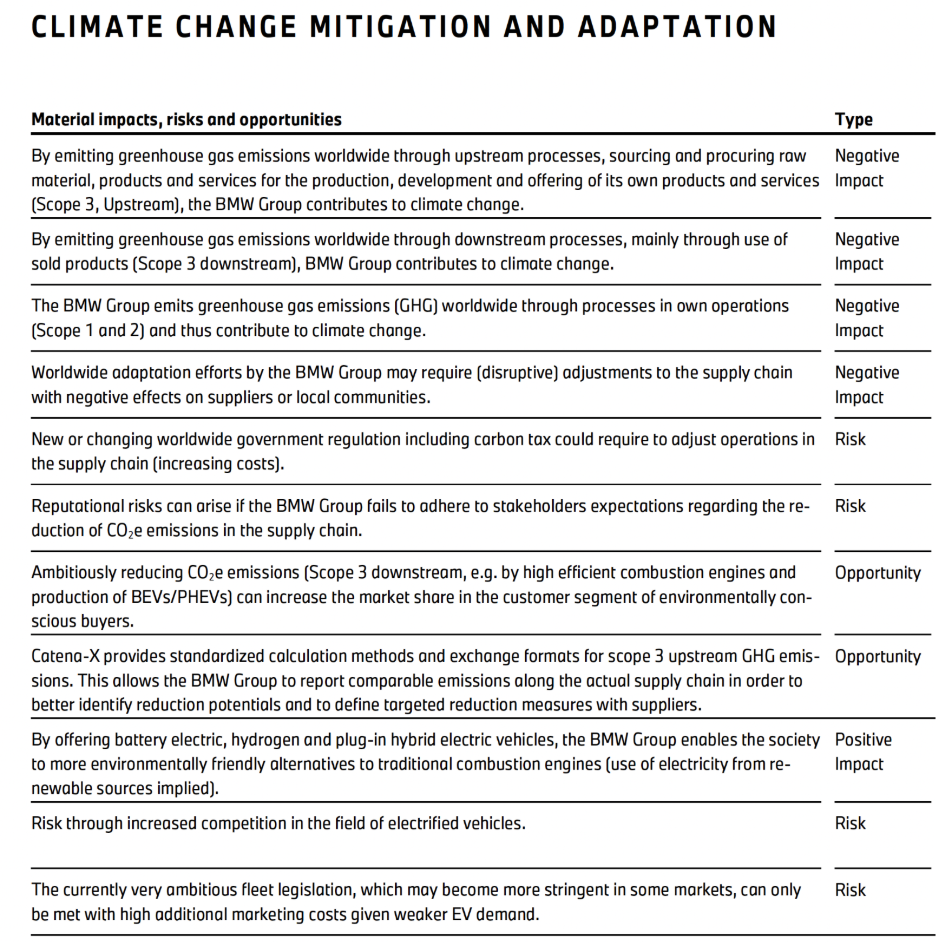
BMW Group had chosen to disclose its IROs at the start of each report section (i.e. E1, E2, S1), rather than listing them all upfront in the SBM-3 section.
But when we asked an AI to extract the IROs from each company’s report, BMW came back: zero IROs across all ten ESRS topics.

This was a striking result, since BMW’s report (in section SBM-3) says that they included “85 material impacts, risks and opportunities across 31 sustainability sub-topics.”
The AI had read that sentence. It even processed the number 85 and continued past it without flagging the contradiction with its own zero count. The AI did not have the context that IROs are foundational to an ESRS disclosure: a count of zero against a stated total of 85 should have set off every alarm. The AI looked under the sub-topic categories for the labels it had been told to find, did not find them there, and returned zero, satisfied that it had done what was asked. The convention that “IROs must be present somewhere in any ESRS disclosure, and that a zero count against a stated total of 85 means the AI has missed something rather than that the company disclosed nothing”, lives in the reading practice of people who do this work for a living. It does not live in the tokens.
So the AI, looking in one place and not finding what it expected, returned zero.
The full extent of the problem only became visible when the dataset was reviewed by hand. 26 of the 150+ companies in the dataset had the same kind of failure: the IRO extraction came back empty. BMW: zero. BASF: zero. Atos: zero. ASML: zero.
The heatmap built from this extraction was going to be used as a benchmarking tool. A reader looking at it would have seen these European companies with apparently empty materiality assessments and concluded that they had identified no material risks or opportunities at all (the reader would have also lost confidence in our analysis). That conclusion would be precisely wrong. BMW had not identified zero IROs. They had identified 85.
The fix, once we saw what had happened, was to tell the AI that IROs are foundational to an ESRS disclosure: the report is built around them, and they must be present somewhere in the document. If the count came back at or near zero, the AI was instructed to read the document again rather than accept that result, looking for IROs wherever the company had chosen to place them rather than only in the location the original prompt expected. With the new prompt, BMW went from 0 to 85. BASF from 0 to 33. Atos from 0 to 63. The numbers matched the totals the companies themselves had stated in the same documents the AI had been reading the whole time.

What the failure shows
The BMW case is structural. The AI did exactly what it thought it should do, which was to count entries labeled in a specific way in the place it was told to look. But the placement is itself a convention, and the companies in question placed their IROs differently, in ways practitioners in this field recognize at a glance. The deeper miss is that the AI did not have the context that IROs must be present somewhere in any ESRS disclosure. When it did not find what it was looking for in the place it was looking, it returned zero and moved on, instead of flagging that the absence itself was the problem.
This is the effect of decontextualization. The AI complies literally with what it was asked to do. It misses the meaning that lives in the reading practice of people who do this work. That meaning could, in principle, be articulated and put in a prompt. But it does not live there. It lives in the practice, in the convention, in the way analysts have learned to read the documents they are reading.
For a generalist looking at the BMW disclosure, this convention is not obvious. You have to know enough about ESRS, about how companies structure their materiality assessments, about what counts as an IRO in practice. That knowing is exactly the kind of context that the AI cannot supply for itself. Someone has to put it in the prompt. And before someone can put it in the prompt, someone has to recognize that the prompt is missing it. That recognition only happens when a domain practitioner looks at the AI’s output and says “wait, BMW cannot possibly have zero.”
The faculty being lost, or in this case, the faculty the AI could not supply, is what McGilchrist calls context-holding. The capacity to hold the situated whole that the system cannot see. The capacity to read the structure of a document as itself meaning-bearing.
McGilchrist’s frame for this faculty is direct:
“For the same reason that the right hemisphere sees things as a whole, before they have been digested into parts, it also sees each thing in its context, as standing in a qualifying relationship with all that surrounds it, rather than taking it as a single isolated entity. Its awareness of the world is anything but abstract.”
The Master and His Emissary, p. 49
The right hemisphere, in this account, does not see context as a layer added on top of the parts. It sees in a way that has context built in from the start. Each thing is grasped as standing in a qualifying relationship with all that surrounds it. The whole is what is primary.
For a senior practitioner reading BMW’s report, this is how reading works. You see the table of IROs at the start of each report section. You immediately understand them as IROs because the document is built that way and the standard is built that way and the field is built that way. You do not have to consciously work through any of this. The reading is contextual by default.
For an AI, the relationship is not even visible. The structure of the document is whitespace and headers and indentation as far as the tokens are concerned. Whatever convention is operating in the field, however obvious it is to a practitioner, does not make it into the data the AI has to work with.
The e-waste chart, in passing
There is a second version of this trait I want to name briefly before closing. Article four develops it in detail, but the connection to decontextualization is worth flagging here.
Earlier this year I was reviewing a deck produced by an AI. One of the slides showed a bar chart comparing the environmental impact of different industries: electronics, fashion, aviation, shipping.
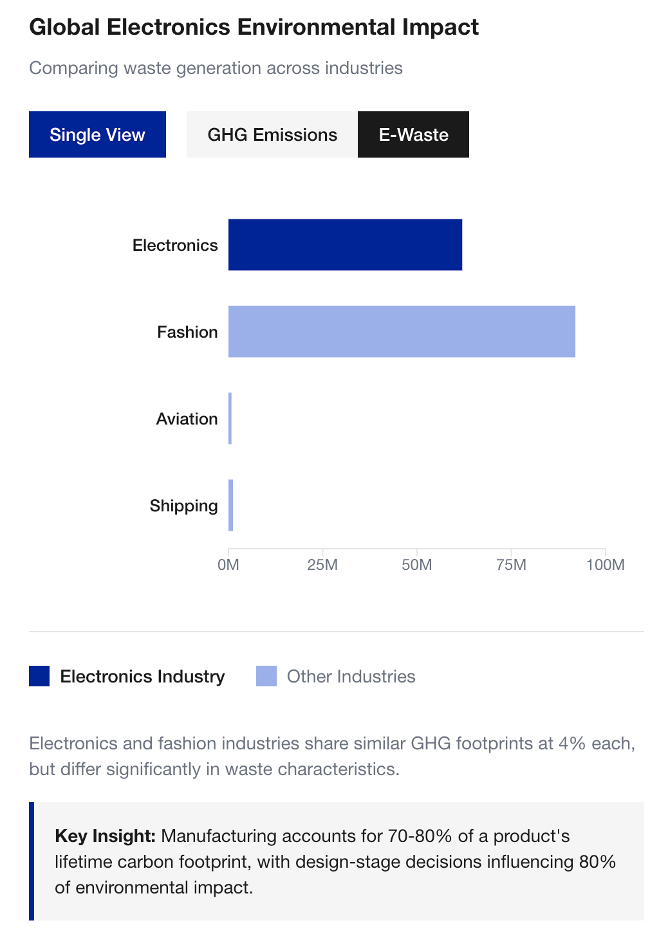
The chart was labeled “E-Waste,” and it showed the fashion industry generating more e-waste than the electronics industry.
This is highly doubtful. Fashion does not produce e-waste, by definition. E-waste is electronic waste: discarded computers, phones, screens. The category exists specifically to capture what the electronics industry generates at end-of-life. Fashion industry waste is textile waste, water pollution, chemical emissions.
The AI that produced the chart had taken the broader concept “environmental impact” and flattened it onto a single axis labeled E-Waste, without recognizing that the categories underneath measure different things. Fashion and electronics share a “global environmental impact” framing, but E-waste is not how the overlap should be described.
This is the same trait as the Ørsted cross-reference and the BMW case, in a different manifestation. The AI processed the literal content (industries, environmental impact, waste) without access to the layer of meaning that distinguishes the categories.
Article four develops what happens when this output is challenged. The full exchange is frustrating to read once you see what is going on.
What this means
This article is about decontextualization and its effects on accuracy: AI reads tokens and misses what surrounds them. Better prompts can patch a particular miss, the way the BMW prompt was fixed. The next BMW will use a different convention the prompt has not been written to handle. The next Ørsted will be a sentence whose role only makes sense if you know how documents work. The AI will keep reading the tokens. Someone with context-holding will keep needing to read the situation.
The BMW fix worked because we knew where to look. We told the AI to go back and scan for IROs because they are foundational to the document, and the next extraction read the documents correctly. But the underlying problem stays. There will always be conventions, structures, reading practices that have not been articulated. There will always be situations in which the meaning of the content lives in the situation rather than in the tokens. The AI will always be reading the tokens. Someone with context-holding will always need to be reading the situation.
The danger of this trait is not that the AI sometimes makes errors of this kind. The danger is that the errors are invisible to the AI. There is nothing inside the system that registers “the structure here is doing semantic work I am not reading.” The errors only become visible when a practitioner with context-holding looks at the output and notices something is wrong. If that practitioner is not there, or does not look, or does not have the time, the errors propagate.
In the BMW case, the practitioner was there, the practitioner looked, the practitioner noticed. The error did not propagate.
Increasingly, AI extractions feed into dashboards, briefings, board materials, and reports for clients, and the human collaboration is often perfunctory or absent. The output is plausible-looking, the analyst is busy, the deadline is tight. The errors land in places where they affect decisions.
Article three takes the second trait, language-dependence and the loss of the tacit, and develops it through a piece of analysis I produced where the AI got every fact right and missed the two things any experienced reader would have caught. The two articles share a deeper structural concern: that AI’s mode of attention is missing some of the layers human practitioners depend on, and that the missing layers will not be added by improvements to the technology.
What context-holding requires, at minimum, is a person in the loop who has been doing this kind of work long enough to know what the conventions are, what the structures mean, what kinds of failures to watch for. That person is what the Ørsted and BMW cases had. The next article asks what happens when the work being done is harder to convention-check, and the person in the loop needs to bring something subtler than structural reading: a feel for whether the output sounds right in the context it is supposed to live in.