

There’s a well-documented phenomenon in public sector planning called goal displacement. The means to an end gradually becomes the end itself. An organization is set up to achieve an outcome. Over time, the metric used to measure progress toward that outcome becomes the primary target. The number gets managed. The thing the number was supposed to represent does not.
Goodhart’s Law captures it: when a measure becomes a target, it ceases to be a good measure.
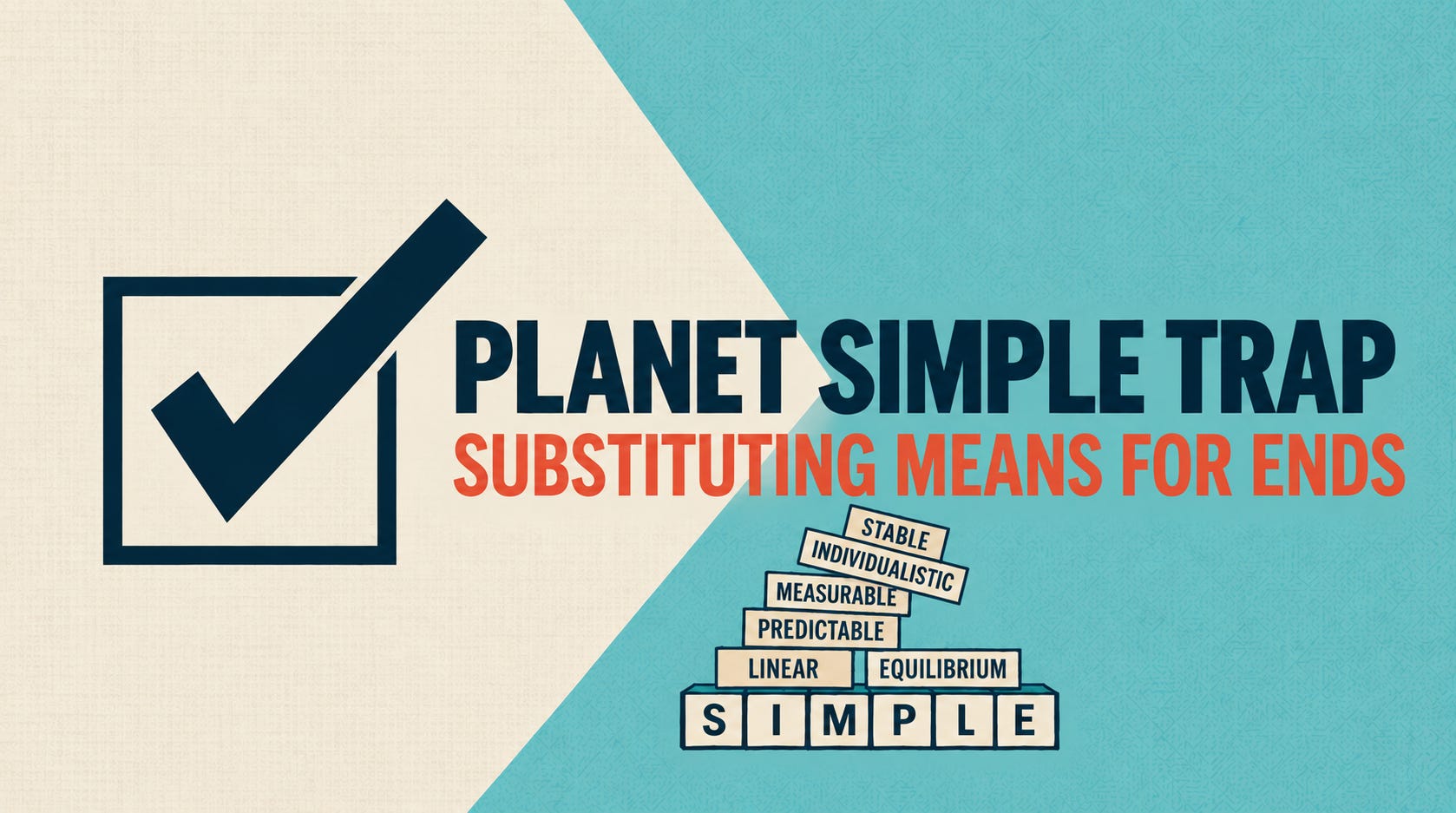
Corporate climate scenario analysis is currently going through exactly this displacement. It’s the last Planet Simple trap in this series, and a fitting one to end on, because it’s the trap that swallows all the others.
What climate scenario analysis is for
The purpose of climate scenario analysis, as the TCFD originally framed it, is to develop a climate-resilient strategy. Understanding the financial effects of climate change is a step in that process. The endpoint is the strategy.
That strategy is what gets stress-tested across multiple futures. It’s what informs decisions about capital allocation, operations, and long-term direction.
In practice, for a large share of companies, the endpoint has become the number. The financial quantification (“we may see a 1 to 2 percent impact to revenues”) has become the deliverable. The analysis is complete. The box is ticked. The strategy has not changed.
Spurious certitude, in its most visible form
I reviewed an analysis recently in which a company disclosed a 1 percent revenue impact from climate-related reputational effects. The report noted that there were no established methodologies for calculating the figure, and that it had been derived through “expert consensus.”
That figure is not meaningful. A group of experts agreeing on 1 percent doesn’t constitute a verifiable estimate of a nonlinear, context-specific phenomenon. The precision implied by the number is illusory.
If I were an investor in that business, the 1 percent would not reassure me. I’d want to know: what are the genuine uncertainties driving the exposure? What is the company doing to learn more and adapt over time? None of that lives inside a percentage.
What the analysis should produce
Scenario analysis done well produces a set of questions. It surfaces the assumptions and uncertainties that matter most. It identifies which strategic choices hold up across futures, and which depend on conditions that may not last. It creates a foundation for ongoing learning.
The output is a sharper strategy, and a clearer view of what you have to keep watching. If the output is a number, the process was a sensitivity analysis.
What this series has been about
Each of the ten traps in this series is a different version of the same mistake: applying a Planet Simple framework to a challenge Planet Simple was never built to handle.
CSR offsets harm without changing the model. Engineering resilience aims at return to the prior state. Outcome vulnerability assumes projections drive decisions. Scenario analysis masquerades as sensitivity analysis. Adaptive management collapses into incrementalism. The materiality matrix ranks the unrankable. The most likely scenario replaces range with false certainty. Aggregate scores hide independent risks. And scenario analysis ends with a number when it should begin with one.
In every case, the genuine insight (about systemic risk, about uncertainty, about the interdependence of business and environment) has been contained and neutralized by a familiar framework that was never built to hold it.
The antidote is a different relationship with uncertainty: one that treats what you don’t know as the most important thing to be honest about, rather than a gap to fill with a number.
That’s leaving Planet Simple.
This is part of the Planet Simple Traps series, exploring the tools and frameworks that look rigorous but quietly reinforce the assumptions holding corporate sustainability back. Based on Leaving Planet Simple by Dr. Alex Gold.